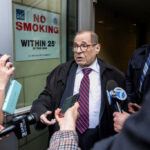

Rep. Jerry Nadler’s remarks during a House Judiciary Committee hearing set off a rapid and intense political backlash, not because of a single stray phrase, but because of how his language intersected with an already volatile national debate over immigration enforcement, federal authority, and the visibility of law enforcement operations.
Nadler, a longtime Democratic lawmaker from New York, framed his comments as a warning about what he described as “fascism in our streets,” arguing that masked enforcement actions create confusion, fear, and the potential for violent misunderstandings.
This is demented. Democrats once again openly calling for violence!!! https://t.co/FSKl9t0Hqy
— Donald Trump Jr. (@DonaldJTrumpJr) February 3, 2026
At the center of the controversy was Nadler’s hypothetical scenario. He suggested that if an individual were confronted by a masked person, that individual might reasonably believe they were being kidnapped and could feel justified in using lethal force in self-defense.
While Nadler did not explicitly instruct or encourage violence, critics focused on the implication that such a response could be seen as understandable, particularly when applied to federal agents conducting immigration enforcement. In a climate where tensions around ICE operations are already high, the phrasing carried significant weight.
Nadler expanded his criticism by describing what he characterized as aggressive and unlawful enforcement tactics, including agents entering homes without warrants and detaining individuals in ways he said stripped them of dignity. He referenced incidents involving people being shot or detained under circumstances he portrayed as excessive, emphasizing imagery of force, fear, and chaos. Supporters of Nadler’s broader argument viewed these remarks as part of a longstanding Democratic critique of ICE tactics, especially those involving plainclothes or masked officers.
Jerry Nadler is one of the highest ranking Democrats in the House of Representatives and he is openly calling for people to shoot federal law enforcement.
This is despicable behavior from an elected official and I’m sure the leftwing media will cover it extensively. https://t.co/hmbV43h43H
— JD Vance (@JDVance) February 3, 2026
The reaction from prominent Republicans was swift and sharply worded. Vice President JD Vance accused Nadler of openly calling for violence against federal law enforcement, labeling the comments “despicable behavior from an elected official.” Donald Trump Jr. echoed that sentiment, calling the remarks “demented” and accusing Democrats of once again encouraging violence. Both framed the issue not as a rhetorical misstep, but as a serious escalation with real-world consequences for officer safety.
The New York Post reported that the exchange occurred during a formal committee hearing, underscoring that the comments were made in an official setting rather than an offhand interview or social media post. That context amplified the scrutiny, as statements made during congressional proceedings are often treated as signals of party priorities and messaging.