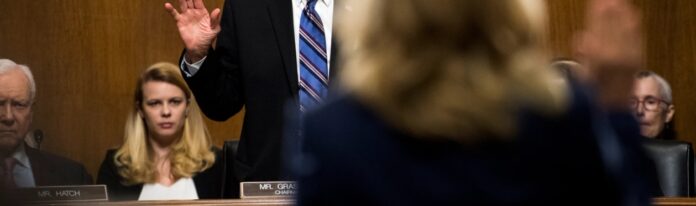
The Judiciary Committee’s FBI oversight hearing opened with a blunt thesis: under Director Patel, the Bureau is clawing back toward a law-enforcement mission after years of politicization—and Congress intends to force that course correction to stick.
The chair framed the moment against a grim backdrop—the assassination of Charlie Kirk, a recent school shooting, and the killing of a Ukrainian refugee—then pivoted to performance metrics and structural changes meant to signal a reset: 23,000 violent offenders arrested since January 20; more than 1,500 child predators and 300 human traffickers taken down; over 4,000 children recovered; agents shifted from Headquarters back to Field Offices; “Most Wanted” captures and MS-13 extraditions logged. It was, in effect, a scorecard, and an argument that capacity and focus are returning.
The oversight blade, however, was aimed squarely at the Bureau’s recent past. The committee previewed new whistleblower materials on “Arctic Frost,” described as an FBI matter opened by former agent Tim Thibault that later fed Special Counsel Jack Smith’s elector probe.
The allegation is sweeping: that the case ballooned well beyond election issues to place 92 Republican entities and individuals—ranging from the RNC and RAGA to Turning Point USA—under investigative scope. If borne out, that would elevate the story from misjudgment to a systemic predicate problem, with legal and reputational consequences for both DOJ and the FBI. The promised release of records with Senator Johnson will test those claims in public.
BREAKING: Sen. Chuck Grassley announces a whistleblower has exposed the program “Arctic Frost” for targeting 92 Republican groups, Charlie Kirk’s TPUSA among them.
All records will be made public today.
“These new records show that Arctic Frost was much broader than just an… pic.twitter.com/krqWQse4Hr
— Benny Johnson (@bennyjohnson) September 16, 2025
The chair also revisited well-worn but newly documented episodes: the handling of Peter Navarro (including an audio recording of subpoena service the committee says DOJ later mischaracterized), and the “Clinton Annex”/“Durham Annex” materials—now declassified—that depict unpursued evidence in the Clinton email matter and contemporaneous intelligence asserting a campaign plan to link Trump to Russia. The through-line is not subtle: key choices cut in one partisan direction, and exculpatory or exonerating leads went cold. Whether that narrative survives broader context and full case files is precisely what oversight is designed to test.
Perhaps the most combustible disclosure came last: two additional FBI FD-1023s from separate confidential human sources, on top of a previously public 1023, all referencing allegations tied to the Biden family. The chair was careful to stress what 1023s are and are not—source reporting, not proof—and to frame the question narrowly: what did the FBI do to validate or discard the claims, and what did it conclude? That is an evidentiary challenge more than a political one; the line between documenting tips and predicating investigations is where the Bureau’s tradecraft—and its credibility—lives.
Set against those critiques was a pointed defense of Patel’s early tenure, highlighted by whistleblower remediation. According to the chair, roughly twenty whistleblowers across agencies have seen reinstatements, clearance restorations, or compensation since August, with ten from the FBI alone. One prior whistleblower’s formulation—“Ensuring that they no longer work at the FBI isn’t retribution, it’s responsible leadership”—was deployed to argue that house-cleaning is both underway and justified.
Two strategic choices stood out. First, limiting the Director to a single ten-minute round concentrates the exchange and reduces the Bureau’s ability to run out the clock—a signal that the committee intends to do the talking while putting documents on the table. Second, the decision to release materials contemporaneously raises the stakes; public scrutiny can clarify, but it can also harden narratives before the Inspector General or courts weigh in.
The core issues are technical but plain. Were investigative predicates properly established and scoped? Did political considerations bias resource allocation (e.g., reassignments away from child exploitation to January 6 work)? Were high-impact cases handled with procedural parity across parties? And has the Bureau rebuilt internal guardrails—venue, predication, Woods files, CHS validation—to prevent mission drift?