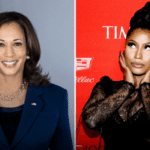

The intersection of politics, celebrity influence, and information credibility took center stage this week as former Vice President Kamala Harris responded to rapper Nicki Minaj’s apparent support for President Donald Trump—offering a reaction that quickly ignited backlash and renewed debate over how public figures engage with dissenting voices.
During an interview, Harris framed Minaj’s position not as a matter of disagreement, but as a consequence of what she described as “mis- and disinformation.” Her comments suggested that differences in political alignment may stem less from ideology and more from access to—or interpretation of—facts.
In doing so, Harris leaned into a familiar argument increasingly used across political discourse: that misinformation is a primary driver of public division.
But it was her phrasing that drew the most attention. Referencing the need for shared factual grounding, Harris remarked that people must be “on the same page about the fact that 2 plus 2 will always equal four.”
The line, delivered with a tone critics interpreted as dismissive, was widely seen as implying that those holding opposing views—including Minaj—may lack basic understanding rather than simply holding different perspectives.
That perception fueled immediate reaction. Critics argued that the comment went beyond addressing misinformation and veered into questioning the intelligence of political opponents and their supporters. In an environment already marked by deep polarization, such framing risks reinforcing the very divides it seeks to explain.
At the same time, Harris’s broader point reflects a real and ongoing concern within political and media circles: the role of information ecosystems in shaping public opinion.
The challenge, however, lies in how that concern is communicated. When arguments about misinformation are perceived as condescension, they can undermine the credibility of the message itself.
Minaj, like many high-profile entertainers, occupies a unique space in political discourse—capable of reaching audiences that traditional political figures often cannot. That influence makes reactions to her statements more consequential, particularly when they come from senior political leaders.