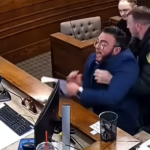

Courtrooms are built on structure—who speaks, when they speak, and how they conduct themselves. Once that structure breaks down, everything that follows escalates quickly. That’s exactly what happened in this Oklahoma custody hearing.
What began as a routine proceeding shifted when attorney Rob Hopkins repeatedly interrupted the judge and pushed back against her authority. Judges have broad discretion to control their courtroom, and contempt warnings are typically the final step before enforcement. In this case, those warnings didn’t de-escalate the situation—they intensified it.
The turning point came when Hopkins framed the conflict as discrimination tied to gender identity. That accusation didn’t resolve anything in the moment; it raised the stakes. The judge’s response—stating she didn’t know Hopkins and focusing on behavior rather than identity—kept the issue anchored, from her perspective, in courtroom conduct.
Once the contempt call was effectively made, the process became procedural.
Bailiffs entered. At that point, the objective shifts from argument to compliance. That’s where the situation unraveled. Instead of submitting to removal, Hopkins physically resisted—spreading across the bench, shouting, refusing restraint. That resistance is what transformed a courtroom dispute into a physical confrontation.
From there, the scene followed a predictable pattern.
More officers entered. Commands were repeated. Resistance increased. Volume escalated. Claims of distress—“you’re hurting me,” “I can’t breathe”—became part of the struggle. Whether those claims reflect actual medical distress or are part of resistance tactics, they complicate the moment for officers, who still have to complete the arrest.
What stands out is how quickly the courtroom lost control of its own environment. Spectators remained mostly passive, but the disruption spread beyond the room—drawing attention from hallways and turning a contained hearing into a public incident.
There are two separate tracks here.
The first is legal: contempt of court, failure to comply, and the authority of a judge to maintain order. On that track, the outcome is straightforward—noncompliance leads to removal and potential charges.
The second is behavioral: how an officer of the court conducts themselves under pressure. Attorneys are given leeway to advocate aggressively, but that boundary ends where disruption and defiance begin. Once it crosses into physical resistance, the professional role effectively collapses.
Hopkins’ claim that the incident was tied to discrimination will likely be argued outside the courtroom—in complaints, appeals, or public statements. But inside that room, the judge’s decision rested on conduct, not identity.