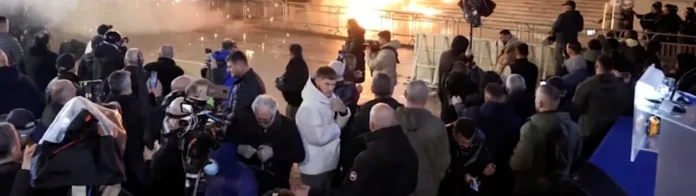
Thousands of anti-government protesters clashed with riot police in Albania’s capital, Tirana, this week, as mounting anger over a high-profile corruption case spilled into the streets.
The unrest centers on Deputy Prime Minister Belinda Balluku, who was indicted by a special prosecutor over allegations that she was improperly influenced in awarding a public contract for the construction of a 3.7-mile tunnel in southern Albania. Prosecutors claim she favored a particular company in the tender process.
Albania’s Special Court Against Corruption and Organized Crime suspended Balluku from office in November. However, Prime Minister Edi Rama appealed the suspension to the Constitutional Court, which reinstated her in December. Balluku has denied the allegations, dismissing them as “mudslinging, insinuations, half-truths and lies.” Rama has refused calls to remove her from government.
The opposition Democratic Party, led by former Prime Minister Sali Berisha, organized the latest demonstrations, urging supporters to demand Balluku’s resignation and denounce what they describe as systemic corruption under Rama’s leadership.
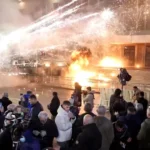
Tuesday’s protest turned violent when demonstrators threw rocks and Molotov cocktails at government buildings. Security forces responded with tear gas and water cannons. According to The Associated Press, at least 16 protesters were treated for injuries and 13 were arrested.
Berisha has claimed the demonstrations are fundamentally peaceful and aimed at defending democratic institutions, accusing Rama of undermining the justice system and centralizing power.
Critics of the current government argue that the scandal has reinforced public perceptions of entrenched corruption. Agim Nesho, a former Albanian ambassador to the United States and the United Nations, told Fox News Digital that many Albanians view Rama’s decade-long tenure as marked by the consolidation of authority and persistent allegations of cooperation with organized crime.
Albania has struggled with corruption for decades. The country ranks 91st out of 182 nations in Transparency International’s 2025 Corruption Perceptions Index. Although both ruling and opposition figures have faced allegations of wrongdoing over the years, public trust in political institutions and the judiciary has steadily eroded.
The political turmoil comes at a sensitive time for Albania’s long-standing ambition to join the European Union. The country became an official EU candidate in 2014. The European Commission’s 2025 report noted progress in judicial reforms and anti-organized crime efforts, but ongoing corruption allegations could complicate accession talks.
The United States has also played a role in Albania’s reform efforts, supporting the creation of the Specialized Anti-Corruption Structure (SPAK) and investing resources through the State Department to strengthen rule-of-law institutions.
Observers warn that sustained instability could slow Albania’s path toward European integration. Nesho argued that both Washington and Brussels must remain engaged to ensure reforms continue and democratic safeguards are reinforced.