
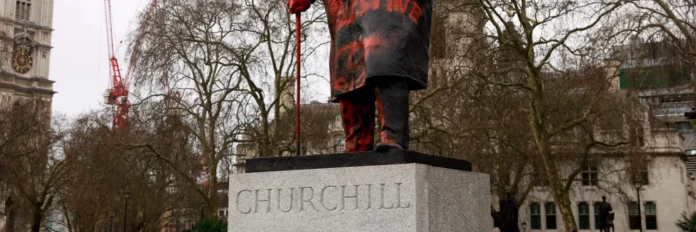
In the early hours of the morning, one of Britain’s most iconic monuments became the center of a dramatic political statement. The statue of former United Kingdom Prime Minister Winston Churchill in Parliament Square was vandalized with red graffiti, prompting a swift police response and an arrest within minutes.
According to the Metropolitan Police, officers were alerted shortly after 4 a.m. and arrived on the scene within two minutes. A 38-year-old man was taken into custody on suspicion of racially aggravated criminal damage.
Authorities confirmed that the statue and its base had been marked with bold red messages, including “NEVER AGAIN IS NOW,” “ZIONIST WAR CRIMINAL,” and “GLOBALISE THE INTIFADA!”
Images circulating online show the historic monument streaked in red paint, the graffiti stark against the bronze likeness of the wartime leader. Parliament Square, a symbolic heart of British political life, has long been a focal point for protests and demonstrations. Yet the targeting of Churchill — a towering figure in British history and a symbol of World War II resistance — adds a charged historical dimension to the act.
Shortly after news of the arrest broke, a Dutch activist group claimed responsibility. In a post shared on Instagram, the group identified as @freethefilton24nl stated that it had organized and carried out the protest.
The post included a pre-recorded video statement from a man identifying himself as Olax Outis, a citizen of the Netherlands and member of “Free the Filton 24 NL.”
In the video, Outis declared that he had traveled to the United Kingdom specifically to deface the statue, describing Churchill as “one of history’s most well-known war criminals.” The group’s public claim of responsibility suggests that the act was premeditated and politically motivated rather than spontaneous vandalism.
The incident unfolds amid heightened tensions surrounding global conflicts and historical legacies. Churchill remains a revered figure to many for his leadership during Britain’s darkest wartime hours, while critics have increasingly scrutinized aspects of his imperial policies and wartime decisions. The graffiti’s language reflects contemporary geopolitical grievances, linking historical figures to modern political disputes.
For law enforcement, the focus remains on criminal damage and public order. The swift response by officers underscores the sensitivity surrounding Parliament Square, where statues of influential leaders stand not merely as art, but as enduring symbols of national identity.


