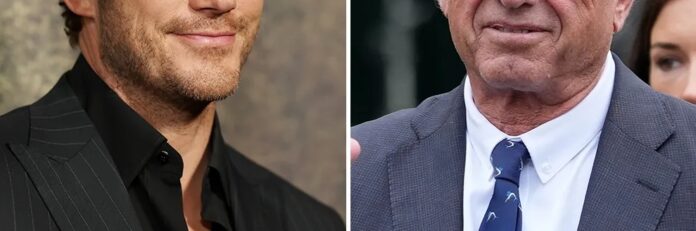
Chris Pratt has once again found himself in the crosshairs of Hollywood politics — this time for voicing support for his own family member, Robert F. Kennedy Jr., and the health-focused agenda he has branded as “Make America Healthy Again.”
Speaking with Bill Maher on Club Random, the Marvel star explained that while he doesn’t agree with Kennedy on every issue, he appreciates his willingness to tackle toxins in food and other bipartisan concerns.
Pratt’s approach was strikingly measured. “I hope there are certain things that he oversees that seem to be supported in a bipartisan way, like getting terrible, toxic stuff out of our kids’ food,” Pratt said. “If you just do that, that’s amazing.”
He added that his goal was not to reflexively oppose anyone simply because of politics. “I’d hate to be so mired in hatred… that any success from [an administration] is something I’d have an allergic reaction to.”
Maher echoed the sentiment, calling Kennedy a “great guy” while advising him to reconnect more directly with his past work as an admired environmental lawyer. Both Maher and Pratt pushed back against caricatures of Kennedy as a conspiracy theorist, insisting instead that his independence and stubbornness — while sometimes controversial — were also the source of his credibility.
This latest exchange comes against the backdrop of Pratt’s uneasy relationship with Hollywood’s political orthodoxy. In the run-up to the 2024 election, Pratt drew fire for an essay urging Americans to be “honorable winners and graceful losers,” a neutral stance that contrasted sharply with his father-in-law Arnold Schwarzenegger’s vocal endorsement of Kamala Harris.
Pratt’s essay, published just days before Trump’s historic return to the White House, was savaged online as “vapid” and “low-value,” even though its message was one of unity and service.
Pratt’s history of controversy runs deeper. From being labeled “Hollywood’s Worst Chris” in 2020 over his suspected right-leaning politics and his church membership, to backlash over his comments about his wife and newborn daughter, the actor has repeatedly been a lightning rod. Yet at every step, colleagues like Robert Downey Jr. and Mark Ruffalo have defended him, insisting his character does not match the attacks.
What Pratt’s comments about Kennedy reveal is consistent: he is less interested in tribal politics than in hearing people out, even when he disagrees. In an era where Hollywood stars are expected to loudly embrace one side, Pratt’s refusal to play the game — whether by backing Trump, Harris, or Kennedy — is itself the rebellion.