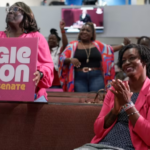

Florida state Rep. Angie Nixon is heading into the November Senate election with a platform calling for the abolition of Immigration and Customs Enforcement, a moratorium on deportations, Medicare for All and an array of federally funded programs.
Nixon scored a surprise victory in Florida’s Democratic Senate primary over Alexander Vindman, setting up a general election contest against Republican Sen. Ashley Moody, who was originally appointed to the seat by Gov. Ron DeSantis.
The primary victory puts considerably more attention on Nixon’s campaign platform, which embraces many policies associated with the democratic socialist left.
At the center of her domestic agenda is what her campaign calls the “Working Families Guarantee.”
According to Nixon’s campaign website, the proposal includes Medicare for All, universal childcare, paid family and sick leave, a national rent freeze, an eviction moratorium and a universal jobs program.
Nixon says she would help finance her agenda by increasing taxes on billionaires, reducing the influence of large political donors and cutting U.S. spending on foreign wars and military operations.
Healthcare sits at the top of her priority list.
Her campaign calls for Medicare for All with medical treatment “free at the point of service, with no premiums, no deductibles, no copays, and no surprise bills.”
The proposed system would also cover reproductive healthcare.
Nixon is similarly proposing a major expansion of government involvement in childcare and education. Her platform includes universal pre-kindergarten and childcare, along with what she describes as “cradle-to-career” public education.
That would include tuition-free public colleges and trade schools, cancellation of student debt and higher teacher salaries.
Housing represents another major component of the platform. Nixon calls for construction of “millions” of new affordable housing units nationwide and an expansion of Section 8 housing vouchers.
Her immigration proposals are likely to produce some of the sharpest contrasts with Moody.
Nixon explicitly calls for abolishing ICE and rebuilding the federal immigration enforcement system “from scratch.”
According to her campaign, a replacement system should include “civilian oversight, due process protections, and a mission that reflects American values instead of terror tactics.”
She also supports a “swift path to citizenship for Dreamers and undocumented residents, and a moratorium on deportations pending a full audit of enforcement practices.”
On criminal justice, Nixon calls for ending what she describes as “mass incarceration.” Her proposals include federal marijuana decriminalization and greater reliance on treatment rather than incarceration for substance abuse.
She also wants to “demilitarize” police departments.
Foreign policy presents another notable part of Nixon’s agenda, particularly given her promise to reduce overseas expenditures to help pay for domestic programs.
Her platform calls for “surging humanitarian aid into Gaza and Westbank” and pursuing a political path toward Palestinian self-determination. Nixon also favors restoring U.S. participation and funding across United Nations agencies.
Her campaign additionally describes the “climate crisis” as an “existential threat” and supports granting statehood to Washington, D.C.
Taken together, the proposals give Florida voters a particularly clear ideological contrast in November.