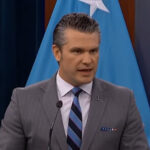

The Pentagon briefing room doesn’t usually double as a stage for offbeat questions, but Friday’s exchange with War Secretary Pete Hegseth veered sharply into unfamiliar territory—and didn’t take long to draw a reaction.
It started when a reporter from TMZ’s newly launched Washington bureau pressed Hegseth with a question that cut away from policy and straight into personal psychology. Instead of asking about strategy or operations, the reporter wanted to know what it feels like to authorize military force. Was there an adrenaline rush? Fear? A sense of power?
Hegseth didn’t dodge, but he didn’t indulge the premise either.
“That’s a very TMZ question,” he said, immediately drawing a line between the tone of the inquiry and the setting. From there, he pivoted hard back to doctrine. His focus, he explained, isn’t on emotion but on execution—making sure U.S. forces have what they need to succeed, carry out missions within legal boundaries, and return home safely.
TMZ DC asks Pete Hegseth how he feels whenever the US military rains down bombs
TMZ: “Do you have an adrenaline rush? Are you scared? Do you feel like you’re on a power trip?
Hegseth: “That’s a very TMZ question.” pic.twitter.com/UcaXxdAkw5
— John Loftus (@JohnCFLoftus1) April 24, 2026
His language was direct and unambiguous. War, he said, is inherently violent and demands difficult decisions. The priority, in his framing, is ensuring American forces hold the advantage and survive the fight. “It’s our guys that come home and their guys that do not,” he added, summarizing the mindset he described as guiding those decisions.
The moment didn’t end there. A second TMZ reporter followed up with a question that leaned more philosophical than operational, asking whether the Department of War—recently renamed from the Department of Defense—should instead be called the Department of Peace.
Hegseth’s answer kept the same throughline but shifted tone slightly. He called it a “great question,” then tied the idea back to what he described as a proactive approach: achieving peace through strength. In his explanation, the purpose of waging war effectively is to secure stability on the other side of conflict, not prolong it.
Then came a line that stood out even in a briefing full of unusual turns. Hegseth said the U.S. military, in his view, should be awarded the Nobel Peace Prize every year, arguing that its global presence underwrites security not just for the United States but for other nations as well.