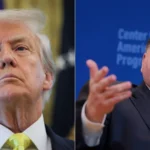

Two of the most prominent Democrats in Washington spent Sunday warning Americans about the supposed dangers of “nationalizing” elections, invoking constitutional limits and the primacy of state control. The irony, however, was difficult to miss. House Minority Leader Hakeem Jeffries and Senator Adam Schiff were not condemning a fully formed policy proposal, but reacting to an offhand remark by President Donald Trump—while conveniently ignoring their own party’s recent and very real push to federalize elections when Democrats held power.
House Minority Leader Hakeem Jeffries on Trump’s call for Republicans to “take over” running elections: “What Donald Trump wants to do is try to nationalize the election. Translation: steal it. And we’re not going to let it happen.” pic.twitter.com/jGflGaguAn
— State of the Union (@CNNSOTU) February 8, 2026
The controversy began after Trump, speaking casually in an interview with former FBI Deputy Director Dan Bongino, suggested that Republicans could never win elections again if the millions of illegal immigrants who entered the country under President Joe Biden were not removed.
In that context, Trump mused that Republicans should “take over the voting” in certain jurisdictions and even used the phrase “nationalize the voting.” The White House later clarified that Trump was referring to states where election integrity had been questioned and emphasized that he has never formally advocated a federal takeover of elections.
That nuance did not slow Democratic responses. Jeffries appeared on CNN’s State of the Union and argued that election procedures constitutionally belong to the states. Pressed by Dana Bash on why Democrats oppose measures like the SAVE Act—despite overwhelming public support for voter ID—Jeffries insisted that states should decide for themselves how to conduct elections. He then accused Republicans of pursuing “clear and blatant voter suppression,” claiming they feared free and fair elections.
When Bash suggested that bipartisan voter ID requirements might remove a major point of contention, Jeffries doubled down, framing Trump’s remarks as an attempt to “nationalize the election” and equating that with stealing it. Schiff struck a similar tone on ABC’s This Week, asserting that Trump intended to subvert elections and suppress votes, and once again raising alarms about hypothetical actions Trump might take if dissatisfied with election outcomes.
Sen. Adam Schiff on President Trump’s call to “nationalize” state elections: “He’s prepared to try to take some kind of action to overturn the result, and we really shouldn’t question that.” https://t.co/mPgqzgikhs pic.twitter.com/qKxEiiUyuh
— This Week (@ThisWeekABC) February 8, 2026
What made these denunciations remarkable was not their intensity, but their selective memory. Just five years earlier, both Jeffries and Schiff strongly supported H.R. 1, the “For the People Act,” a sweeping Democratic bill that would have dramatically centralized control over elections at the federal level. While marketed as an anti-corruption and voting-access measure, critics argued that it amounted to a full-scale federal takeover of election administration, stripping states of their traditional authority.
Election law experts such as Hans von Spakovsky warned at the time that H.R. 1 would make elections more vulnerable to manipulation, not less, while simultaneously restricting political speech through aggressive campaign finance rules. In substance, it would have done precisely what Democrats now claim to fear: nationalized the rules governing how elections are run.