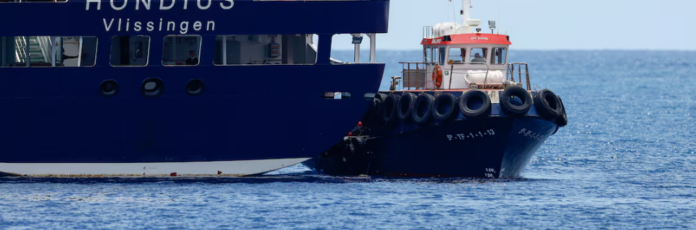
Eighteen American passengers aboard the MV Hondius — the cruise ship at the center of a deadly hantavirus outbreak in the South Atlantic — returned to the United States early Monday as federal health officials intensified containment and monitoring efforts following multiple deaths linked to the virus.
The U.S. passengers disembarked from the Dutch-flagged expedition cruise ship in the Canary Islands on Sunday before boarding a government-arranged medical repatriation flight to Nebraska, according to health officials.
The outbreak aboard the MV Hondius has already turned deadly. Three passengers have died, and the World Health Organization confirmed Monday that at least nine people have tested positive for hantavirus connected to the voyage. A French woman became the latest confirmed case after French Health Minister Stéphanie Rist announced her diagnosis.
The ship originally departed southern Argentina on April 1 and traveled across the South Atlantic with stops at several remote islands before the outbreak emerged. Nearly 150 passengers from 23 different countries were onboard during the voyage.
Of the 18 Americans returned to the United States, 16 are now in Nebraska, where they are being evaluated and monitored at the National Quarantine Unit at the University of Nebraska Medical Center — one of the country’s most specialized infectious disease containment facilities. One passenger has already tested “mildly” positive for hantavirus and is currently being held in biocontainment at the facility.
Two additional American passengers continued on to Atlanta. Health officials said one member of the couple is currently showing symptoms, and both are now staying in a specialized biocontainment unit at Emory University.
Health officials stressed that hantavirus symptoms can take up to 42 days to appear after exposure, meaning passengers will remain under close observation for weeks.
“For the passengers getting off the ship, I’d say, ‘Welcome to Nebraska,’” said Dr. Ali Khan, dean of the College of Public Health at the University of Nebraska Medical Center. “You are coming to the premier facility in the United States, if not the world, to take care of you.”
The virus involved in the outbreak is believed to be the Andes strain of hantavirus, a rare but dangerous variant that scientists have studied for decades. Unlike COVID-19, the Andes virus is not considered highly contagious between humans, though prolonged close contact can spread the disease in some cases.
Public health experts say that distinction may have prevented a much larger crisis.
“We do know that you can get small clusters of disease, but in 30 years we’ve never seen any large outbreaks,” Khan said. “So this is unlikely to become a pandemic.”
Still, criticism is mounting over the federal government’s handling of the situation.
Lawrence Gostin, a global health law professor at Georgetown University, accused federal agencies of reacting too slowly as the outbreak unfolded aboard the ship.
“The CDC was missing in action for quite a long time,” Gostin said. “Better late than never — but it is very late.”
The Department of Health and Human Services strongly disputed that claim, insisting the response has been coordinated across multiple agencies, including the State Department, CDC, and Administration for Strategic Preparedness and Response. Officials pointed to emergency operations centers, quarantine planning, state notifications, and deployments to both the Canary Islands and Nebraska as evidence of the government’s ongoing response efforts.
For now, health officials believe the outbreak will likely remain contained. But experts warn the incident exposed serious vulnerabilities in America’s preparedness for future infectious disease emergencies.
“If this was a highly transmissible virus,” Gostin warned, “you could imagine what chaos we would be facing now.”