
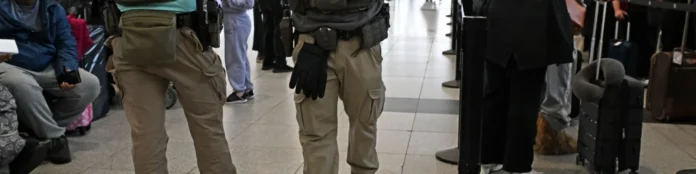
Twenty-five years after September 11, a fight is brewing at American airport gates over immigration enforcement, passenger information and exactly how far airlines must go when ICE agents arrive looking for someone about to board a plane.
And this one gets complicated quickly.
According to The Wall Street Journal, Immigration and Customs Enforcement officers have sharply increased enforcement activity at airports, making nearly three dozen arrests per day in July. The targets reportedly include foreign nationals who overstayed visas and people with final orders of removal.
But airlines including Southwest and JetBlue have pushed back against aspects of those operations, particularly when agents seek access to aircraft, passenger information or secure boarding areas.
The airlines aren’t saying immigration laws don’t apply inside airports. The dispute concerns what ICE can demand from airline employees, what legal documentation agents need, and how enforcement operations should be conducted without disrupting airport security and passenger operations.
Airlines for America, the trade organization representing major U.S. carriers, met with Department of Homeland Security officials in July.
“Airlines have had constructive discussions with ICE and TSA to ensure if law-enforcement activity occurs at an airport, there are proper procedures and protocols in place to prioritize the safety and security of all involved,” a spokesperson told the Journal.
Sounds bureaucratic enough.
Then you get to what reportedly happened in Dallas on July 25.
According to documents reviewed by the Journal, an ICE agent appeared near the gate of a Southwest flight headed to Orlando and called out the name “David” while attempting to locate someone.
Agents then sought to board the aircraft using an administrative warrant.
Southwest employees refused.
The gate agent reportedly wanted a judicial warrant signed by a judge before allowing the officers aboard. ICE administrative warrants, by contrast, are issued within the executive branch and signed by authorized immigration officials rather than independent judges.
Airline employees also reportedly declined to disclose passenger information or allow agents to look at a computer screen while passengers boarded.
At one point, an ICE officer asked a Southwest employee for the employee’s name as part of an investigation.
The employee reportedly declined to provide it.
Now we have a genuine collision between federal immigration enforcement and corporate procedures.
ICE’s position is that administrative immigration warrants provide authority for immigration arrests under federal law. Airlines have their own obligations involving passenger privacy, aviation security and access to restricted areas. Put those together at a busy boarding gate and suddenly a question that sounds simple — “Can ICE arrest this person?” — becomes a fight over where, when and under what procedures that arrest occurs.