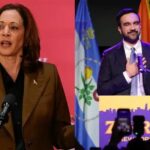

Former Vice President Kamala Harris is once again drawing attention as speculation about the Democratic Party’s 2028 presidential race begins to intensify. According to a new report, Harris has recently been reaching out to some of the party’s most progressive figures, including New York City Mayor Zohran Mamdani and prominent advocates for Palestinian causes.
The outreach comes at a moment when the Democratic Party is wrestling with growing ideological divisions, particularly after several progressive candidates backed by the Democratic Socialists of America scored notable primary victories in New York and Colorado.
According to Axios, Harris spoke by phone with Mamdani last week. The conversation reportedly focused on the future direction of the Democratic Party, with both agreeing to continue the discussion in a longer meeting.
Mamdani’s recent rise has made him one of the party’s most closely watched progressive figures, and Harris’ reported outreach has fueled renewed speculation about how she intends to position herself should she seek the Democratic presidential nomination in 2028.
Axios also reported that Harris has held private meetings with several Palestinian-American activists, including Abbas Alawieh, a co-founder of the Uncommitted Movement, and longtime activist James Zogby.
The Uncommitted Movement emerged during the 2024 election cycle as a protest against former President Joe Biden’s handling of the war between Israel and Hamas. Organizers encouraged Democratic primary voters in several states to cast “uncommitted” ballots rather than support Biden, arguing that the administration had not done enough to address civilian suffering in Gaza.
During the 2024 campaign, Harris repeatedly expressed support for Israel’s right to defend itself while also calling for greater humanitarian protections for Palestinian civilians.
According to Axios, Harris also reflected on the issue in her memoir, writing that she had “pleaded” with Biden to take a more public stance in support of Palestinians in Gaza.
She also wrote that she had consistently argued “American tax dollars should never be used to target civilians or destroy entire communities.”
Not everyone on the left is convinced by Harris’ recent outreach.
Palestinian-American political strategist Rania Batrice questioned whether Harris’ engagement represents a lasting shift or simply a change in political strategy.
“Why should we trust her now?” Batrice said.
“If this change is real, she has an opportunity to prove it. Until then, skepticism isn’t just understandable, it’s warranted.”
Others see Harris’ recent moves primarily through the lens of presidential politics.
Republican strategist Mike Madrid told the New York Post that positioning ahead of a potentially crowded 2028 Democratic primary may be driving the outreach.
“This is about positioning for the 2028 primary where no candidate knows where the lane for support for Palestinian rights is going to be but they know there’s going to be one,” Madrid said.
He acknowledged that the strategy carries political risks but argued it reflects broader changes inside the Democratic coalition.
“No question this is a risky move but it’s one transforming both parties and the calculus at the moment has become it’s better to do something than nothing,” he said.
Madrid added that Harris’ outreach reflects how rapidly Democratic politics surrounding Israel and the Palestinians has evolved in recent years.
Conservative commentator Jim Geraghty also examined the political implications in a column for National Review.
While expressing skepticism that Harris will ultimately become the Democratic nominee again, Geraghty suggested her recent moves indicate she may no longer be seeking to occupy the party’s ideological center.
“I remain a skeptic that the Democratic Party will nominate Kamala Harris as its presidential nominee for a second straight cycle,” Geraghty wrote.
He also questioned whether progressive voters would ultimately embrace Harris if other well-established figures enter the race.
“If you’re a Mamdani-loving progressive, I’m not sure you want to hitch your wagon to the damaged goods of Harris—particularly if a longer-term ally like Alexandria Ocasio-Cortez is likely to be in the mix of candidates,” he wrote.