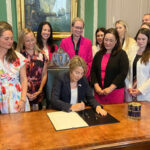

Well, Massachusetts just moved the line on abortion again, and nobody watching the bill-signing ceremony could mistake how Gov. Maura Healey and her supporters felt about it.
They were smiling. They were applauding. They were celebrating.
Healey signed the Prioritizing Patient Access to Care Act on Monday, changing Massachusetts law governing abortions later in pregnancy. The previous legal framework generally permitted abortion through 24 weeks, with later procedures allowed under specified medical circumstances. The new law expands the circumstances under which abortions can be performed after that point.
And this is where the language matters, because both sides are describing the same law in dramatically different terms.
Abortion-rights supporters call it expanded reproductive freedom and protection for families facing catastrophic medical circumstances. Pro-life opponents see something much darker: fewer legal protections for unborn children at the stage of pregnancy when the stakes could hardly be higher.
Michael Robinson, executive director of SPUC Pro-Life, watched the signing ceremony and didn’t mince words.
“This is what our culture has become: the deliberate ending of an innocent human life presented as progress and celebrated as victory,” Robinson wrote.
“There is nothing progressive about abortion. Every child deserves the right to be born.”
Now, stay with me, because the word “progress” is doing an awful lot of work here.
Will the Catholic-in-name-only gov of Massachusetts be denied Holy Communion this Sunday?🤔
These women, clapping & flapping like moronic circus seals, applaud the ability to slaughter their own children. This image is beyond dystopian; it’s purely demonic. https://t.co/J60msrVC7N
— NurseClaire (@NurseClaire2) August 11, 2026
A law changing is a fact. Whether that change represents progress is a moral judgment. And when the subject is abortion, Americans don’t remotely agree on the underlying moral premise.
Healey defended the legislation by focusing on parents confronting devastating fetal diagnoses.
“Today, mothers and fathers and families who experience these devastating diagnoses — and they are devastating, heartbreaking — now they’ll be able to make their own choices,” she said.
That’s the case abortion-rights advocates want voters to consider: a family receives terrible medical news late in a pregnancy, and the government shouldn’t dictate what happens next.
Pro-life advocates begin from a completely different point. They regard the unborn child as a human being whose life deserves legal protection, including when that child has a severe disability or medical diagnosis.
Put those two premises next to each other and you can see why this argument gets so heated so quickly.
But here’s another important distinction.
The claim that Massachusetts has simply authorized abortion “up to birth” with no limitations whatsoever goes further than the details provided here establish. The law expands access to abortions later in pregnancy, but the precise circumstances and medical requirements matter. Those provisions should be described accurately rather than reduced to the broadest possible slogan.
Likewise, statistics about abortions overall don’t necessarily tell us why abortions occur late in pregnancy.
Live Action has cited 2024 research saying 95 percent of abortions nationally were performed for “elective or unspecified reasons.” That’s relevant to the broader abortion debate, but it doesn’t automatically establish the reasons behind the much smaller subset of procedures occurring after 24 weeks.
Those are two different questions.
None of this makes the pro-life objection disappear.
Quite the opposite. Once a pregnancy has reached an advanced stage, opponents argue that society has an even stronger obligation to consider the unborn child’s interests alongside those of the mother.
And that’s why the images from Healey’s signing ceremony hit pro-life viewers so hard.
For the people standing behind the governor, the applause represented increased freedom for patients and families.
For people such as Robinson, they were watching political leaders celebrate a law that reduces protections for unborn human life.
Same room. Same applause. Completely different understanding of what had just happened.