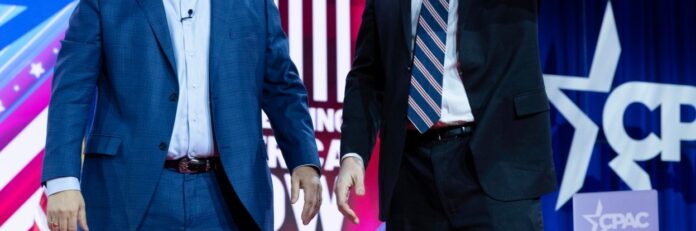
Senator Ted Cruz appears to be angling for a political comeback — not just to reclaim the conservative spotlight, but to challenge the very soul of the GOP as the 2028 presidential race begins to take shape.
The Texas senator, once a Tea Party firebrand, now finds himself playing the part of elder statesman in a party increasingly pulled between populist nationalism and traditional conservatism. As Cruz eyes a second presidential bid, his new battleground isn’t just against Democrats or even old Republican rivals — it’s against a new ideological foe within: Tucker Carlson and the “New Right.”
In a private meeting last month with Morton Klein, president of the Zionist Organization of America, Cruz signaled what many had suspected: he’s seriously considering a White House run. The subject emerged naturally, tethered to a conversation about growing antisemitism — not on the far left, but on the right, where Cruz believes it’s gaining traction under the influence of figures like Carlson.
The senator has made no secret of his disdain for the popular conservative pundit, whose criticisms of Israel and embrace of isolationist foreign policy now place him at the heart of the GOP’s ideological tug-of-war. Cruz’s rebuke has been public and pointed, calling Carlson’s views “poisonous” and accusing him of fueling antisemitic sentiment — a claim Carlson flatly denies.
But Cruz isn’t merely clashing with Carlson in the media sphere. His real fight may be with Vice President JD Vance, a Carlson ally and the leading MAGA heir apparent in a post-Trump GOP. Already, Cruz has criticized Vance in private donor conversations, warning that his foreign policy vision could endanger America’s national security interests.
This friction highlights a dramatic reversal in the party’s internal dynamics. Once the insurgent outsider in 2016, Cruz is now positioning himself as the defender of Reaganite foreign policy, free market capitalism, and staunch support for Israel — the very positions that defined the GOP before Trump. But in a political environment that increasingly rewards bombast, populism, and skepticism of global entanglements, Cruz’s revival may be an uphill climb.
His pitch? A Republican Party that still believes in strong alliances abroad and limited government at home. In a party now split between America First populists and legacy conservatives, Cruz is trying to stitch together a coalition — one that still respects Trump but doesn’t surrender to the populist tide. It’s a delicate balance, made more difficult by the backlash from voices like Rep. Marjorie Taylor Greene, who declared bluntly, “All of us hate Ted Cruz.”
Yet Cruz is undeterred. He’s banking on a different base of support: donors, activists, and voters who are wary of where the MAGA wing is headed — particularly on foreign policy and social issues like rising antisemitism. His recent clashes with Carlson, including over the latter’s interview with white nationalist Nick Fuentes, have drawn sharp lines. Cruz isn’t backing down, calling Carlson’s behavior “dangerous” and accusing him of amplifying extremist voices.
And while Trump has so far remained publicly neutral, his silence only fuels the uncertainty about 2028. Will he endorse Vance? Will he run again? Or will he sit back and watch his two ideological offspring — one a traditionalist, the other a populist — battle for the future of his movement?
Meanwhile, others like Rand Paul are also staking claims to ideological territory, warning against what he sees as the party’s abandonment of free-market principles in favor of protectionism and economic populism. “They tax, tax, tax,” Paul said of the pro-tariff wing. “That has never been a conservative position.”
It’s a risky play — and in today’s Republican Party, risk doesn’t always equal reward