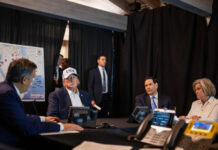
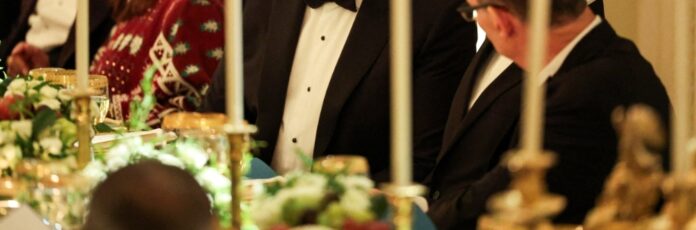
In a spectacle that blended global power, tech futurism, and political theater, billionaire Elon Musk returned to the White House Tuesday night for a high-profile black-tie dinner with President Donald Trump and Saudi Crown Prince Mohammed bin Salman—a rare reunion that signals a cautious détente between two of the most influential men on the planet.
The guest list was stacked: top executives from Silicon Valley, Wall Street financiers, energy barons, and sports moguls filled the East Room for the lavish evening. But all eyes were on Musk, whose appearance marked his first formal return to the White House since his very public rupture with Trump earlier this year.
That fallout began in June, when Musk—then serving in an advisory capacity at the Trump administration’s Department of Government Efficiency (DOGE)—broke ranks over what he dubbed the “big, beautiful bill,” a sweeping legislative package Trump touted as a generational investment in American infrastructure, AI, and defense. Musk objected, warning it would add trillions to the national debt and undo the very cost-cutting measures DOGE was designed to implement.
What followed was a rare and sharp exchange of insults between two high-powered allies. Musk took to X, his social platform, to vent:
“Dems would control the House and Republicans would be 51-49 in the Senate [without me]. Such ingratitude.”
Trump fired back, reportedly threatening to yank federal contracts from SpaceX and Tesla, though he later softened his tone:
“The better they do, the better the USA does, and that’s good for all of us,” he wrote on Truth Social in July.
Fast-forward to Tuesday night, and the tension seemed dialed down—at least for now. Musk, dressed in a classic tuxedo, shared a brief handshake with the president and was seated at a table that included senior figures from the U.S. Department of Energy, Saudi Aramco, and the AI think tank led by Oracle co-founder Larry Ellison.
Also present was Crown Prince Mohammed bin Salman, whose economic ambitions for a post-oil Saudi Arabia have increasingly aligned with Musk’s vision of a tech-driven future. The pair previously met in May at the U.S.-Saudi Investment Forum in Riyadh, where Musk promoted a broader Tesla-Saudi partnership.
Indeed, Musk’s presence at Tuesday’s event follows Tesla’s official launch in the Saudi market in April, where it unveiled its EV lineup at the Bujairi Terrace. The presentation doubled as a showcase for the company’s ambitions beyond cars—from solar energy and autonomous transport (the long-awaited Cybercab) to robotics, including the Optimus humanoid prototype.
While no official policy announcements were made during the dinner, sources familiar with the event say discussions touched on AI infrastructure, critical minerals, and space cooperation, areas where U.S. and Saudi interests now intersect more than ever. Musk’s companies, particularly SpaceX and Tesla’s AI division, are seen as central players in both nations’ near-future technological strategies.