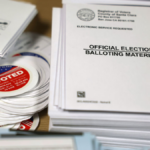

President Donald Trump issued an executive order in March to change federal mail-ballot rules. The goal was to have new standards ready for the 2028 presidential election. However, the Supreme Court declined to lift a blocking order on September 14. This decision means the new rules cannot go into effect for the upcoming midterms.
Legal experts say the future of this plan depends on how the Court views the President’s power. According to Fox News Digital, Michael Morley, a law professor at Florida State University, said the outcome is uncertain. “If the Court views this primarily as an attempt by the President to regulate federal elections, the Court is likely to invalidate it,” he stated. He added that Congress has not given the President broad power in this area.
The order would let the Postal Service reject ballots that do not meet new standards. It also targets ballots from people not on state-submitted lists of eligible voters. According to Fox News Digital, the administration argues these are just administrative rules for the post office.
“In contrast, the Court may instead view the new rules primarily as administrative requirements for the post office to ensure efficient operations and protect the integrity of the [mail],” Morley noted. If the Court sees it this way, the rules might survive. But the odds look tough. Chad Mizelle, a senior legal fellow at America First Policy Institute, told Fox News Digital that at least six justices seem to think the administration will lose on the merits.
This legal fight changes how your local election officials handle mail-in ballots. The order tries to force states to share voter lists with the federal government. Some states, like California, are fighting back hard. Governor Gavin Newsom signed 13 new bills on September 19 to stop federal interference.
He claimed these laws make it a felony to seize ballots before they are certified. “Donald Trump won’t stop until he can exert dictatorial control over your free vote and disenfranchise millions of people this November,” Newsom said. This creates a direct clash between state and federal power.
Justice Brett Kavanaugh of the Supreme Court voted to uphold the injunction. He noted that forcing new rules right before an election likely breaks federal law. This timing matters for voters who rely on mail ballots. The Court’s hesitation shows that the President cannot simply rewrite election rules by executive order.
Republicans are still pushing for these changes despite the legal roadblock. James Blair, the President’s midterm political chief, told Breitbart News that the strategy involves turning out less-frequent GOP voters. He said elections are not all national and not all local. Blair argued that candidates must create a binary choice between themselves and their opponents. He believes Republicans are being undercounted in public polls. The fight for control of the House and Senate continues as the election nears.
The final result of this legal case will decide if the new mail rules ever happen. If the Court strikes them down, the status quo remains. If they uphold them, the Postal Service gains new power to reject ballots. For now, the 2028 election remains uncertain. The Court has not made a final decision on the merits of the case. This uncertainty leaves voters and officials in limbo until the next ruling. The future of mail voting depends on nine justices and their view of the Constitution.